Food manufacturers are responsible for ensuring that products meet applicable requirements for safety, quality, composition, and labeling. As formulations, ingredients, processing methods, and regulatory expectations become more complex, internal quality-control programs may not always provide the specialized analytical capabilities needed to evaluate every potential risk.
Food analytical chemistry testing performed by an external laboratory can complement in-house quality programs by providing specialized instrumentation, analytical expertise, independent verification, and additional testing capacity. These services can support nutrition label validation, chemical contaminant screening, ingredient verification, product quality investigations, and regulatory compliance.
For quality assurance and regulatory affairs leaders, the question is not whether every test should be outsourced. Instead, it is determining when external analytical testing can provide greater confidence in product safety, composition, and compliance.
What Is Food Analytical Chemistry Testing?
Food analytical chemistry testing evaluates the chemical composition and characteristics of food, beverages, ingredients, dietary supplements, and related materials using laboratory-based analytical methods.
Depending on the product and testing objective, analysis may evaluate nutrients, contaminants, pesticide residues, allergens, additives, authenticity markers, or chemicals associated with food-contact materials.
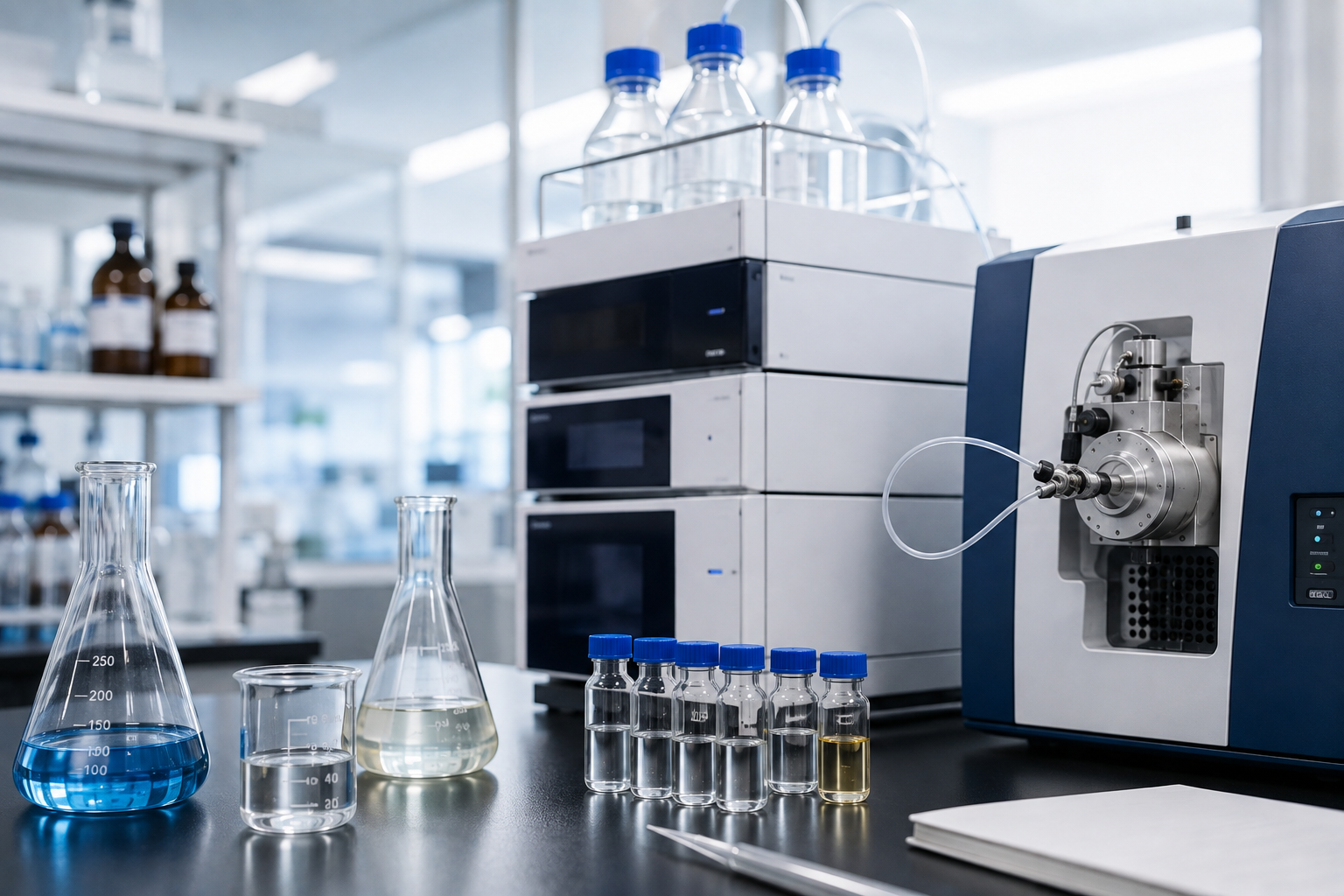
Modern food analysis can require specialized instrumentation such as liquid chromatography-tandem mass spectrometry (LC-MS/MS), gas chromatography-tandem mass spectrometry (GC-MS/MS), inductively coupled plasma mass spectrometry (ICP-MS), and high-performance liquid chromatography (HPLC).
These technologies allow laboratories to identify and quantify compounds across complex food matrices, including chemical contaminants that may be present at trace levels.
Mérieux NutriSciences supports manufacturers with a broad range of food chemistry testing services, including nutritional and labeling compliance, contaminants, pesticide residues, PFAS, allergens, quality and authenticity, and packaging and materials chemistry.
When Should Food Manufacturers Use External Testing Services?
External laboratory testing does not need to replace routine in-house quality control. In many cases, the strongest approach is to use internal testing for routine monitoring while bringing in an external laboratory when specialized expertise, instrumentation, capacity, or independent verification is needed.
1. When Specialized Analytical Capabilities Are Required
Some chemical hazards require analytical methods and instrumentation that may not be practical for every manufacturer to maintain internally.
Examples include:
- Heavy metals
- Pesticide residues
- Mycotoxins
- Veterinary drug residues
- PFAS
- Process contaminants
- Chemical additives
- Packaging-related contaminants
The FDA monitors chemical contaminants and pesticides in the U.S. food supply and notes that food manufacturers have a responsibility to implement preventive controls as needed to significantly minimize or prevent chemical hazards (FDA, 2026a).
External testing can provide access to specialized analytical platforms and technical expertise without requiring manufacturers to purchase, maintain, validate, and continually upgrade every type of analytical instrument.
This can be particularly valuable when a company needs trace-level detection or is evaluating a contaminant that is not part of its routine testing program.
2. When Nutrition Label Validation Is Needed
Nutrition information is another area where analytical chemistry can support regulatory and quality decisions.
Manufacturers may need testing when:
- Launching a new product
- Reformulating an existing product
- Changing suppliers or key ingredients
- Updating a Nutrition Facts panel
- Supporting a nutrition-related claim
- Investigating variation between production lots
- Entering a market with different labeling requirements
Nutrition label validation can provide analytical measurements of components such as protein, fat, carbohydrates, sugars, dietary fiber, sodium, vitamins, and minerals.
Analytical data can help manufacturers determine whether actual product composition aligns with declared nutritional information and identify potential discrepancies before products reach the market.
For QA and regulatory teams, external testing can also provide an independent data set when nutritional information is based on historical data, supplier specifications, calculated values, or a formulation that has changed.
Mérieux NutriSciences provides nutritional and labeling compliance testing to support manufacturers evaluating nutritional composition and product claims.
3. When Chemical Contaminant Risk Needs to Be Evaluated
Chemical contaminants can enter food through agricultural production, environmental exposure, raw materials, processing, storage, or packaging.
Potential hazards include:
- Heavy metals
- Pesticide residues
- Mycotoxins
- PFAS
- Veterinary drug residues
- Process contaminants
- Other environmental contaminants
The FDA identifies environmental contaminants as chemicals that can enter food through contaminated soil, water, or air. Its monitoring programs include toxic elements such as arsenic, lead, cadmium, and mercury, as well as other chemical contaminants (FDA, 2026b).
Processing can introduce another category of risk. Chemical contaminants can form during processes such as heating, drying, frying, roasting, and fermentation. FDA identifies compounds including acrylamide, 3-MCPD esters, glycidyl esters, furan, and certain other process contaminants as areas of ongoing monitoring and research.
A risk-based external testing program can help manufacturers:
- Establish baseline contaminant levels
- Evaluate higher-risk ingredients
- Verify supplier specifications
- Investigate unexpected results
- Monitor emerging chemical concerns
- Support preventive-control programs
- Evaluate finished products before release
For example, Mérieux NutriSciences provides contaminant testing across areas such as pesticide residues, PFAS, heavy metals, mycotoxins, and process contaminants.
4. When In-House Testing Has Limitations
In-house laboratories can provide significant value for routine food quality control. However, internal programs may have limitations related to instrumentation, staffing, testing volume, method availability, or analytical expertise.
A manufacturer may not have the equipment required for a particular analysis or may not perform a test frequently enough to justify maintaining the capability internally.
Pesticide analysis illustrates the complexity that can be involved. The FDA's Pesticide Analytical Manual includes both multiresidue methods and methods designed to detect specific compounds when broader methods are not appropriate (FDA, 2024).
For manufacturers, maintaining this type of specialized capability internally can require ongoing investment in equipment, method development, validation, personnel training, maintenance, and quality systems.
External testing services can provide access to specialized capabilities without requiring the manufacturer to build every analytical capability in-house.
This can be especially useful when a new regulatory concern emerges, a new ingredient is introduced, or a company expands into a product category that requires different analytical methods.
5. When Independent Verification Matters
External testing can also provide an independent check on internal data.
For example, a manufacturer may periodically send products to an external laboratory to verify:
- Nutritional composition
- Ingredient specifications
- Contaminant levels
- Supplier testing results
- Product consistency
- Product claims
Independent verification can be particularly valuable when analytical results are being used to make significant regulatory, quality, or commercial decisions.
The quality system behind the laboratory is an important consideration. ISO/IEC 17025 establishes requirements for the competence, impartiality, and consistent operation of testing and calibration laboratories. Accreditation against the standard is intended to demonstrate that a laboratory is technically competent and capable of producing valid and reliable results.
When evaluating a testing partner, QA teams should therefore look beyond the test menu and consider accreditation, analytical methods, detection capabilities, quality systems, and technical expertise.
6. When Packaging Creates a Chemical Risk
Food chemistry testing is not limited to the food itself.
Packaging materials can pose chemical risks through migration from adhesives, coatings, inks, and substrates. The FDA's food chemical safety program includes chemicals used in food packaging and other food-contact applications as part of its broader food chemical safety activities (FDA, 2026c).
External packaging and materials chemistry testing can help manufacturers evaluate potential migration and food-contact risks before packaging is used commercially.
This can be particularly important when manufacturers:
- Change packaging suppliers
- Introduce new packaging materials
- Move toward alternative packaging formats
- Modify coatings or inks
- Investigate unexpected chemical results
- Need additional food-contact compliance data
Mérieux NutriSciences offers packaging and materials chemistry testing to help manufacturers evaluate chemical risks associated with food-contact materials.
What Should Manufacturers Consider When Selecting a Testing Partner?
Choosing an external laboratory involves more than comparing price and turnaround time. The testing partner should have analytical capabilities, quality systems, technical expertise, and experience relevant to the manufacturer's products and testing objectives.
Accreditation and Quality Systems
An accredited laboratory can provide additional confidence that appropriate quality and competency requirements are being followed.
ISO/IEC 17025 is an international standard for testing and calibration laboratories that addresses competence, impartiality, and consistent operation. Accreditation bodies use the standard as a basis for assessing laboratory competence.
Analytical Method and Detection Capability
The laboratory should have methods appropriate for the food matrix, analyte, and required detection level.
This becomes particularly important when testing for trace contaminants. QA teams should understand the method being used, its detection capability, and the applicable reporting limits.
The right method is not simply the one that detects a chemical. It needs to be appropriate for the product and the regulatory or quality question being asked.
Breadth of Testing Capabilities
Manufacturers may benefit from working with a testing partner that can support multiple analytical needs.
Mérieux NutriSciences provides chemistry testing across nutritional composition, contaminants, pesticides, PFAS, allergens, quality and authenticity, and packaging and materials chemistry.
A broader testing portfolio can simplify testing programs when manufacturers need to investigate several potential risks within the same product or supply chain.
Technical and Regulatory Expertise
Analytical results are only useful when teams understand what they mean.
A testing partner should be able to provide appropriate technical interpretation and help manufacturers understand how results relate to product specifications, regulatory requirements, or risk-management decisions.
For QA and regulatory teams, this can make the difference between receiving a laboratory report and receiving information that can actually support a compliance or quality decision.
Turnaround Time
Testing programs also need to align with manufacturing and commercialization timelines.
Routine testing may be planned well in advance, while investigations, product releases, supplier issues, or regulatory responses may require faster turnaround.
Manufacturers should consider standard turnaround times, rush capabilities, sample logistics, communication, and reporting when selecting a testing partner.
How External Testing Complements In-House Quality Control
The decision does not have to be in-house testing versus external testing.
A combined approach can allow manufacturers to use internal resources for routine monitoring while relying on external laboratories for specialized analyses, independent verification, additional capacity, and emerging risks.
| In-house testing |
External testing |
| Routine quality monitoring |
Specialized analytical methods |
| Frequent production checks |
Trace-level contaminant analysis |
| Established internal methods |
New or emerging chemical risks |
| Immediate process monitoring |
Independent verification |
| Routine specification checks |
Complex investigations |
The appropriate balance depends on the manufacturer's products, processes, risk profile, regulatory requirements, resources, and testing objectives.
Building a Risk-Based Analytical Testing Strategy
The most effective food analytical chemistry testing programs are driven by risk rather than a one-size-fits-all testing schedule.
QA and regulatory teams can consider:
- Ingredient risks — Are certain raw materials more susceptible to contaminants or adulteration?
- Supplier risks — Does supplier location, history, or variability warrant additional verification?
- Processing risks — Could manufacturing conditions contribute to chemical contaminants?
- Packaging risks — Could packaging materials create chemical migration concerns?
- Regulatory requirements — Are there applicable limits, tolerances, or guidance levels?
- Product claims — Does the product rely on nutritional or compositional claims?
- Formulation changes — Could reformulation affect nutritional composition or chemical risk?
- Historical data — Have previous results identified recurring issues?
- Emerging risks — Are new contaminants or regulatory concerns relevant to the product?
The FDA's current approach to food chemical safety includes monitoring contaminants, evaluating chemical risks, and using modern analytical methods and tools. This reinforces the need for manufacturers to maintain testing strategies that can adapt as chemical risks and regulatory priorities evolve (FDA, 2026c).
A risk-based approach allows manufacturers to focus testing resources where they can provide the greatest value.
The Role of External Food Chemistry Testing in Compliance
External food analytical chemistry testing can provide manufacturers with specialized capabilities and independent data to support decisions across food safety, quality, and regulatory programs.
It can help validate nutrition information, investigate chemical contaminants, verify product and ingredient specifications, evaluate packaging risks, and support regulatory compliance.
The strongest testing strategy is not necessarily the one that sends every sample to an external laboratory. Instead, it is the strategy that uses the right analytical capability at the right point in the product lifecycle.
For QA and regulatory leaders, that may mean using internal testing for routine monitoring while partnering with an external laboratory when specialized instrumentation, independent verification, additional capacity, or technical expertise is required.
Mérieux NutriSciences provides chemistry testing services across nutritional and labeling compliance, contaminants and allergens, pesticide residues, PFAS, quality and authenticity, and packaging and materials chemistry. Its analytical capabilities can help manufacturers generate data to support product safety, quality, and compliance decisions.
For manufacturers evaluating their current testing strategy, the key question is not simply:
“Do we need an external laboratory?”
It is:
“Where can external analytical expertise give us greater confidence in the safety, quality, composition, and compliance of our products?”
Need Support With Your Food Chemistry Testing Strategy?
From nutrition label validation to chemical contaminant screening, the right analytical testing strategy can help you make more confident decisions about food safety, quality, and compliance.
Mérieux NutriSciences can help you identify the testing capabilities your products require and provide the analytical expertise, advanced technology, and regulatory support to help manage chemical risks.
References
U.S. Food and Drug Administration. (2024). Pesticide Analytical Manual (PAM). U.S. Department of Health and Human Services.
U.S. Food and Drug Administration. (2026a). Chemical contaminants & pesticides. U.S. Department of Health and Human Services.
U.S. Food and Drug Administration. (2026b). Environmental contaminants in food. U.S. Department of Health and Human Services.
U.S. Food and Drug Administration. (2026c). Food chemical safety. U.S. Department of Health and Human Services.