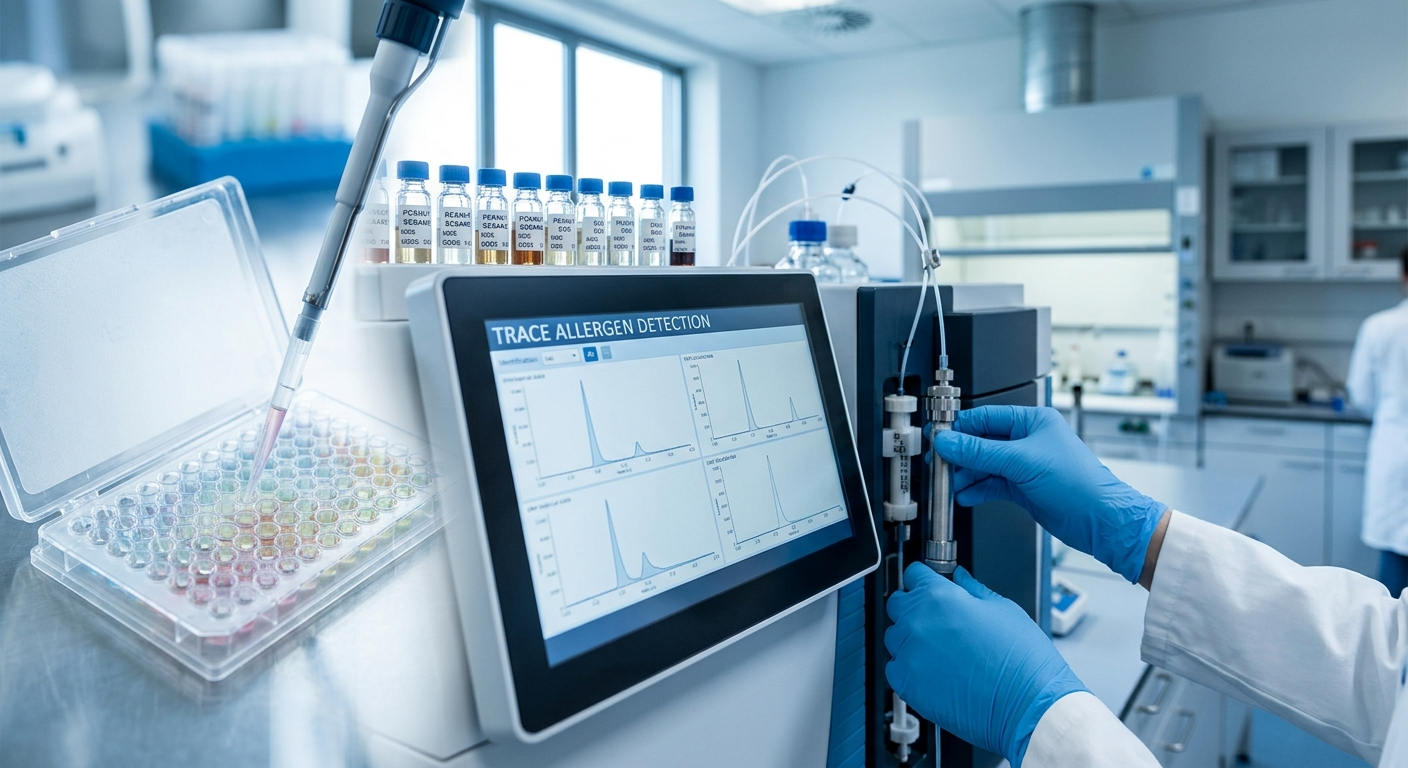
Food allergens remain one of the leading causes of food recalls and consumer safety incidents across the global supply chain. As manufacturing environments grow more complex and ingredient sourcing expands internationally, the risk of unintended allergen cross-contact escalates. Even trace levels of allergenic proteins can trigger severe, life-threatening reactions in sensitive consumers, elevating trace allergen detection from an operational checkpoint to a critical pillar of modern food safety programs.
Undeclared allergens continue to be a leading cause of food recalls in the United States, reinforcing the need for robust preventive controls and highly sensitive analytical testing programs (U.S. Food and Drug Administration [FDA], 2026).
At Mérieux NutriSciences, our chemistry testing services support food manufacturers by delivering advanced analytical detection of allergens, contaminants, and residues using validated technologies such as LC-MS/MS, GC-MS/MS, HPLC, and ELISA.
Why Trace Allergen Detection Dictates Food Safety Success
Food allergies affect millions of consumers globally and remain a major public health concern. In the United States, allergen labeling and control are governed by the Food Allergen Labeling and Consumer Protection Act (FALCPA) and the Food Allergy Safety, Treatment, Education, and Research (FASTER) Act, which requires sesame to be declared as a major allergen (FDA, 2026).
These regulatory frameworks require manufacturers to implement controls that prevent allergen cross-contact throughout production.
Cross-contact can occur at multiple stages, including:
- Shared production equipment and transfer lines
- Ingredient handling and storage systems
- Production scheduling and changeover practices
- Packaging and transportation processes
Because allergic reactions can occur at extremely low levels, manufacturers must rely on proactive verification supported by analytical chemistry testing.
Mérieux NutriSciences Chemistry Testing for Allergen and Contaminant Control
Modern allergen risk management depends on advanced analytical chemistry capabilities to detect and quantify trace-level contamination.
Mérieux NutriSciences chemistry services support food manufacturers through:
These capabilities ensure product integrity across the full supply chain.
Key Benefits of an Analytical Chemistry Program
Sanitation Verification
Confirms that cleaning procedures effectively remove allergenic residues from food contact surfaces and production equipment.
Environmental Monitoring
Detects allergen presence in production environments to identify contamination trends early.
Supplier Qualification
Validates incoming raw materials before they enter production to reduce upstream risk.
Corrective Action Programs
Provides objective analytical data to support root cause investigations during contamination events.
ELISA as the Workhorse of Trace Allergen Detection
Enzyme-Linked Immunosorbent Assay (ELISA) remains one of the most widely used methods for allergen detection due to its sensitivity, specificity, and suitability for routine testing.
Industry and laboratory guidance recognize ELISA as a validated method for detecting allergenic proteins across a wide range of food matrices when properly implemented within accredited laboratory systems (AOAC International, 2024).
High-Value Testing Points in Manufacturing
Raw Ingredients
Detect contamination before materials enter production.
Finished Products
Confirm final product compliance before release.
Environmental Swabs
Identify allergen residues after sanitation procedures.
CIP Rinse Waters
Verify cleaning effectiveness in automated systems.
However, processing conditions such as heat, fermentation, and extrusion can alter protein structures, potentially impacting detectability and requiring method validation (FDA, 2026).
Overcoming Analytical Challenges in Complex Food Matrices
As food formulations become more complex, analytical chemistry methods must account for matrix effects that may interfere with detection accuracy.
ISO-accredited laboratories rely on validated methods to ensure accuracy, repeatability, and regulatory defensibility across different food types and processing conditions (FDA, 2025).
Complementary techniques such as LC-MS/MS and PCR are used alongside ELISA to confirm results and strengthen analytical certainty.
Protecting Brand Integrity Through Regulatory Compliance
Accurate allergen labeling is a legal requirement that protects consumers and brands. Failure to declare allergens properly can result in recalls, enforcement actions, and reputational damage.
A structured analytical testing program supports manufacturers by:
- Verifying supplier declarations
- Supporting precautionary labeling decisions (“May contain”)
- Validating preventive control programs during audits
These systems reinforce HACCP-based food safety frameworks.
Integrating Chemistry Testing into a Full Allergen Management Program
Effective allergen control requires a multi-layered approach supported by analytical verification.
1. Supplier Verification and Gatekeeping
Ensures incoming ingredients meet allergen safety specifications.
2. Sanitation Validation
Confirms removal of allergenic residues from shared equipment.
3. Environmental Monitoring
Tracks allergen presence trends within production facilities.
4. Production Scheduling Controls
Reduces cross-contact risk through optimized production sequencing.
Leveraging ISO-Accredited Laboratory Expertise
ISO/IEC 17025-accredited laboratories provide validated methodologies and technical expertise required for high-confidence allergen and contaminant testing.
Laboratory support includes:
- Routine chemistry and allergen testing
- Method validation for complex matrices
- Environmental monitoring programs
- Root cause investigations
- Regulatory reporting and interpretation
Accreditation ensures consistency, reproducibility, and regulatory defensibility.
Elevating Food Safety Through Analytical Chemistry
Trace allergen detection is a cornerstone of modern food safety systems. Analytical chemistry enables manufacturers to verify sanitation effectiveness, validate labeling claims, and ensure regulatory compliance across global markets.
As supply chains become more complex and product formulations evolve, advanced chemistry testing remains essential for protecting consumers and maintaining brand integrity.
Organizations that integrate analytical chemistry testing into their food safety programs are better positioned to reduce risk, maintain compliance, and strengthen trust.
Don't leave allergen control to chance—partner with our chemistry experts to validate your food safety program today.
References
AOAC International. (2024). Gluten & food allergens program. https://www.aoac.org/scientific-solutions/gfa/
U.S. Food and Drug Administration. (2026). Food allergies. https://www.fda.gov/food/nutrition-food-labeling-and-critical-foods/food-allergies
U.S. Food and Drug Administration. (2025). Regulatory testing laboratory manual of quality policies (ISO 17025 requirements). FDA Field Science and Laboratories. https://www.fda.gov/science-research/field-science-laboratory-manual/laboratory-manual-quality-policies-iso-17025-requirements