What Is Cereulide and Why Is It a Risk in Infant Formula?
Cereulide is a heat-stable emetic (vomit-inducing) toxin produced by certain strains of Bacillus cereus during growth. Importantly, cereulide does not form independently in food; its presence indicates that B. cereus previously grew in the food or in an ingredient at some point in the supply chain. Once formed, cereulide cannot be destroyed by common thermal processing treatments, such as pasteurization, ultra-high temperature (UHT) processing, or reheating, and can remain stable throughout processing and shelf life (Ehling-Schulz, Frenzel, & Gohar, 2021).
Primary strategies to control cereulide in foods include:
- Preventing B. cereus growth before cereulide can be produced
- Testing ingredients and raw materials for B. cereus
- Using analytical chemistry methods to test for cereulide directly
This is especially critical for Infant Formula Safety, where the use of multiple ingredients and raw materials creates numerous opportunities for B. cereus to enter the supply chain, and where tolerance for exposure to cereulide is extremely low in highly susceptible infant populations.
Mérieux NutriSciences offers targeted LC-MS/MS cereulide testing to ensure your infant formula meets global safety standards.
Historical Risks and Emerging Sources in the Supply Chain
Historically, cereulide has been associated with starch- and nutrient-rich matrices that support B. cereus growth under favorable time/temperature conditions (Moravek, Diez, & Ehling-Schulz, 2022).
Frequently reported food categories include:
-
Cooked rice and rice products
-
Cooked pasta, noodles, and other cereal-based foods
-
Mashed potatoes and potato products
-
High-moisture bakery products (doughs and batters)
-
Dairy products, including milk and reconstituted powders
What Did the 2026 Infant Formula Recalls Reveal About Cereulide Risk?
In addition to foods traditionally associated with B. cereus and cereulide risks, recent large-scale recalls of infant formula in early 2026 have demonstrated that other ingredients, such as arachidonic acid (ARA) oil, can also be emerging sources of cereulide contamination (Food Safety Magazine, 2026).
Notably, these 2026 recalls were driven by the analytical detection of the cereulide toxin in the ARA oil ingredient, rather than the detection of B. cereus itself. This underscores that the risk of cereulide can exist independently of finished product compliance for B. cereus. This reinforces the need for manufacturers to:
- Verify absence of hazards in ingredients using targeted hazard-specific methods.
- Maintain stringent supplier verification programs to ensure ingredients are manufactured under conditions that prevent B. cereus growth and cereulide formation.
Learn more about our Cereulide testing services.
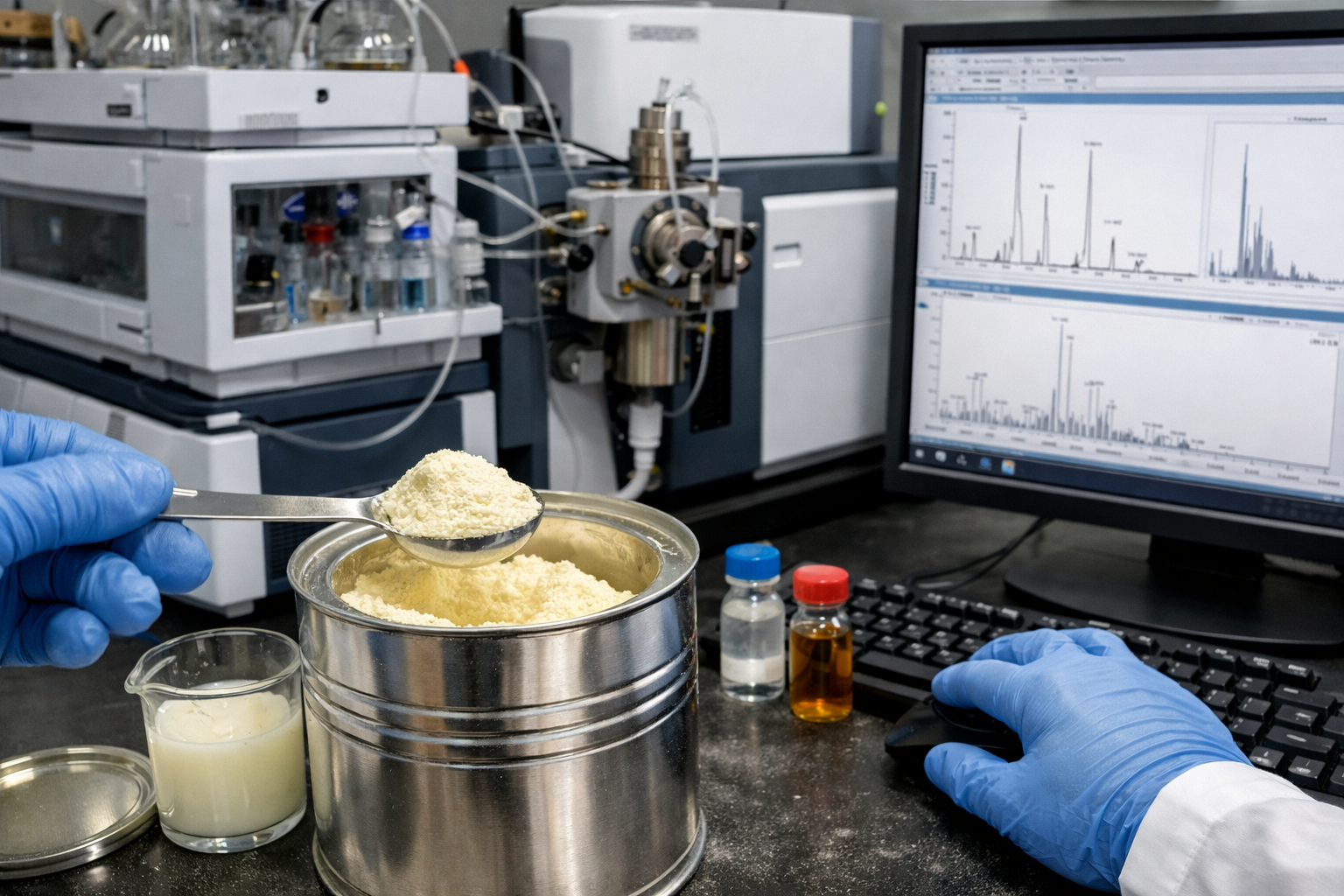
LC-MS/MS Analytical Detection of Cereulide
When verification of cereulide concentration is necessary, direct analytical measurement of the toxin is required. Traditional microbiological testing for B. cereus provides no information on cereulide presence or concentration.
Mérieux NutriSciences provides cereulide testing using ISO 18465:2017 (LC-MS/MS) methodology across accredited laboratories globally. Our North American analytical chemistry method offers:
- Limit of Detection (LOD): 0.017 µg/kg
- Limit of Quantification (LOQ): 0.05 µg/kg
- Validated Performance: Verified for matrices relevant to Infant Formula Safety, including milk powder, ARA powder, and ARA oil.
Mérieux NutriSciences is a global testing partner for Cereulide analysis in China, Germany, and the United States. Having this global presence helps us keep up with changing regulations. Following the EFSA threshold communication, our global partners are working to further lower the LOQ for this method to meet evolving safety standards.
Analytical testing supports confirmation, trending, and investigation, but testing alone does not prevent recurrence.
Strengthening Supplier Verification through Data-Driven Analytical Chemistry and Continuous Monitoring
The recent events emphasize how cereulide risk can be a supply chain control issue. Effective supplier verification programs for Infant Formula Safety should include:
- Preventive Control Alignment: Review supplier food safety plans to ensure hazards are identified with a severity-based approach, specifically accounting for the high-risk nature of infant populations.
- Operational Assessments: Evaluate if supplier processing and storage parameters—including time/temperature controls—are robust enough to inhibit the growth of B. cereus and other pathogens.
- Methodological Verification: Confirm that suppliers utilize suitable sampling and current testing methods to verify that hazards are effectively controlled in ingredients.
- Data-Driven Surveillance: Implement routine reviews of incoming Certificates of Analysis (COAs) to detect subtle shifts or "drifting" trends that may signal an emerging safety risk before it leads to a non-conformance.
- Targeted Verification Testing: Supplement supplier data with independent, targeted sampling and testing of high-risk inbound ingredients to verify supplier compliance.
Because early indicators of emerging risk may be subtle, secure data aggregation and trend analysis—including a Trusted Third Party collaborative model—can support earlier recognition of deviations before they manifest as product-level issues.
Integrated Systems for Infant Formula Safety
Cereulide will remain an area of increased scientific and regulatory attention. The key takeaway from recent recalls is the need for integrated food safety systems that combine targeted analytical chemistry, robust supplier monitoring, and data-driven trend analysis. Organizations that strengthen these foundations will be better positioned to manage the risks of cereulide and other emerging hazards.
As EFSA thresholds and global regulations shift, Mérieux NutriSciences is here to help you navigate the change. Download our flyer on our Cereulide testing services to learn how we assist with risk management, or contact our lab to learn more about our 2026 testing updates.
References
Ehling-Schulz, M., Frenzel, E., & Gohar, M. (2021). Cereulide: The emetic toxin of Bacillus cereus. Toxins, 13(2), 98. https://www.mdpi.com/2072-6651/13/2/98
Moravek, M. B., Diez, A., & Ehling-Schulz, M. (2022). Emerging cereulide risks in food matrices: Analytical detection and safety evaluation. Food Microbiology, 108, 104008. https://www.sciencedirect.com/science/article/pii/S0956713522004431
Food Safety Magazine. (2026, January 15). EFSA to advise on cereulide levels in infant formula following global recall. https://www.food-safety.com/articles/11086-efsa-to-advise-on-cereulide-levels-in-infant-formula-following-global-recall