Menu Labeling Services & FDA Compliance
Meet FDA menu labeling requirements with expert support from Mérieux NutriSciences. Our menu labeling services help restaurants, foodservice operators, and retail establishments calculate calorie and nutrition information, evaluate recipes, and prepare accurate menu labeling information.
Understanding FDA Menu Labeling Requirements
FDA menu labeling regulations require covered restaurants and similar retail food establishments to disclose calorie information for standard menu items on menus and menu boards. Additional nutrition information must also be available upon request.
The federal menu labeling compliance date was May 7, 2018. Establishments should periodically review their operations, menu offerings, and location counts to determine whether the requirements apply.
Mérieux NutriSciences provides regulatory expertise and nutrition analysis services to help food businesses understand and address their menu labeling needs.
Who Must Comply With FDA Menu Labeling Regulations?
Federal menu labeling requirements generally apply to restaurants and similar retail food establishments that:
- Are part of a chain with 20 or more locations
- Operate under the same name
- Offer substantially the same menu items
- Sell restaurant-type foods
Covered establishments may include restaurant chains, franchised locations, grocery stores, convenience stores, and other retail food establishments offering restaurant-type foods.
Examples of applicable foodservice operations include:
- Delis
- Salad bars
- Sandwich and soup bars
- Bakeries
- Self-service foods and foods on display
- Convenience stores
- Grocery and retail chains
Ask Our Experts About Menu Labeling Requirements >>
Menu Labeling Services for Restaurants and Foodservice Businesses
Mérieux NutriSciences offers menu labeling services that combine nutrition analysis, regulatory expertise, and recipe evaluation. As part of our comprehensive food labeling services, we help restaurants and foodservice businesses develop accurate nutrition information to support menu labeling requirements.
Our team can test or calculate nutrition information based on the products and cooking processes used at your locations. We develop required nutrition values and additional nutrition information, while also evaluating standard menu items for allergen and ingredient statements.
Our Menu Labeling Capabilities
- Nutrition Analysis by Database: Calculate nutrition information using available ingredient and recipe data.
- Nutrition Analysis by Lab Testing: Analyze menu items through laboratory testing to determine nutrition information.
- Ingredient Statement Creation: Develop ingredient statements for applicable menu items.
- Menu Labeling Consulting: Receive guidance from regulatory experts on menu labeling requirements.
- Allergen Statement Creation: Develop allergen information based on menu item ingredients.
- Special Diet Analysis: Evaluate menu items for specific dietary considerations.
- Serving Size Evaluations: Review serving sizes used for menu nutrition calculations.
- Recipe Change Analysis: Evaluate how recipe changes affect nutrition information.
- Menu Board Nutrition Reports: Prepare nutrition information for menu and menu board applications.
- Special Ingredient Data Capabilities: Address nutrition analysis needs involving specialized ingredient information.
Nutrition Analysis and Recipe Calculations Using ESHA Genesis
Mérieux NutriSciences uses ESHA Genesis to support menu nutrition analysis and recipe calculations.
Our team can calculate nutrition information across your menu, update recipes, recalculate nutrient values, and analyze menu items for nutrient content.
These capabilities help restaurant and foodservice teams manage nutrition information as menus, ingredients, and recipes change.
Whether your business needs nutrition information for a new menu or updated calculations for existing recipes, our experts can help support your menu labeling requirements.
Contact Our Menu Labeling Experts >>
Frequently Asked Questions About FDA Menu Labeling
Certain grocery stores and convenience stores may be covered if they are part of a qualifying chain and sell restaurant-type foods. Examples include made-to-order sandwiches, self-service foods, and foods on display. Coverage depends on the establishment and applicable FDA requirements.
Restaurants with fewer than 20 locations generally are not subject to the federal menu labeling rule unless they voluntarily register with the FDA. However, applicable state or local requirements may still apply. Businesses should review their specific circumstances to determine their obligations.
Nutrition information should be reassessed when changes to ingredients, recipes, serving sizes, or preparation methods affect the declared nutrient values. Mérieux NutriSciences provides recipe change analysis and nutrition recalculations to help businesses maintain accurate menu information.
Restaurants can determine calorie and nutrient information using appropriate methods, including nutrient databases, laboratory analysis, recipes, and other reasonable approaches permitted by FDA regulations. Mérieux NutriSciences offers database calculations and laboratory nutrition analysis based on menu items, ingredients, and preparation methods.
No. FDA regulations do not generally require laboratory testing for every menu item. Covered establishments may use reasonable methods, including nutrient databases, laboratory analysis, and recipe calculations, provided the resulting nutrition information meets applicable requirements. Mérieux NutriSciences offers both database and laboratory nutrition analysis.
The FDA requires covered restaurants and similar retail food establishments to display calorie information for standard menu items on menus and menu boards. They must also provide additional written nutrition information upon request and display required statements about calorie intake and the availability of nutrition information.
Covered establishments must display calories for standard menu items. Additional written nutrition information must be available upon request, including total fat, saturated fat, trans fat, cholesterol, sodium, total carbohydrates, dietary fiber, total sugars, and protein, along with total calories. Required menu statements also apply.
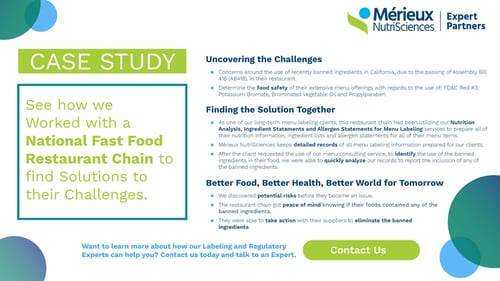
Menu Labeling Case Study
Take a look at a brief overview of a project working with a long-time restaurant client. Using our access to their full menu via our ESHA Genesis database tool, our experts were able to provide a quick turnaround and helped the client take action to eliminate banned ingredients from their products.